Spain’s honra culture of honour
Lazarillo de TormesSpain’s honra culture of honour is presented in Lazarillo de Tormes as a public system of status, etiquette, and reputation whose claims often outrun the resources and conduct that could support them. The squire’s proud gestures conceal hunger and dependence; Lázaro’s final domestic security, meanwhile, rests alongside rumors he chooses to silence. Across these contrasts, honour is not simply an inner virtue but a social performance with material costs and consequences.
Status as a Public Performance
The novel’s squire embodies the distance between recognized rank and actual means. He is an hidalgo, a member of a class whose exemption from taxes is tied to maintaining an appropriate economic status. The need to claim even ridiculous possessions reveals the strain built into that arrangement. His upright bearing, careful attention to clothing and person, and insistence on receiving the proper greetings make his hidalguía legible to those below him, even as his poverty undermines its substance. The figure is both a recognizable product of imperial Spanish society and a literary type: vainly devoted to appearances, yet dependent on the very poor people whose deference helps sustain his status.
The squire’s account of leaving Castilla la Vieja makes etiquette a cause of real displacement. He says he abandoned his home because he would not keep removing his hat first to a local gentleman, even though the other man was richer and of higher standing. To Lázaro’s practical objection that a poorer man might reasonably defer to a superior, the squire answers that honour is the whole capital of respectable men. He insists that an hidalgo owes nothing to anyone but God and the king, and recounts forcing a craftsman to replace a respectful greeting with one that acknowledged his supposed superiority. A gesture as small as who removes a hat first becomes a test of rank, and the effort to win that test has helped leave the squire without a home or livelihood.
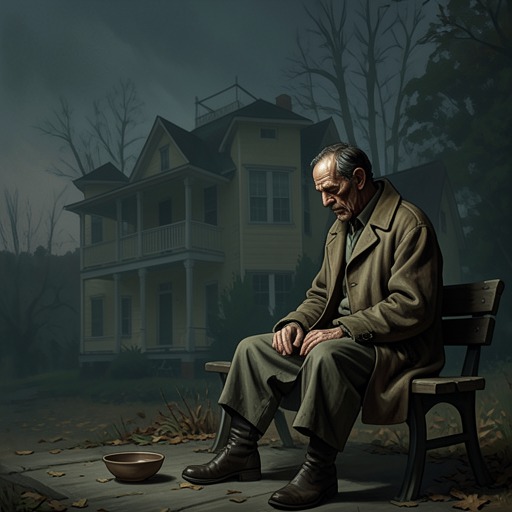
That performance is most exposed in the contrast between the squire’s manner and his household’s deprivation. He leaves the house looking so satisfied and well turned out that strangers might take him for a relative of the Count of Arcos or his chamber gentleman. Lázaro knows, however, that the man has gone a day without eating except for a piece of bread carried by his servant, and that he has dried his washed hands and face on his coat because there is no towel. The servant’s bread, itself hidden against his chest, feeds the master whose bearing conceals the lack. Lázaro’s bitter reflection turns the gap into a social criticism: people suffer for what they call honour more than they would suffer for love of God.
Lázaro’s Education in Honour
The first three masters form a connected education, but their lessons differ. The blind man is Lázaro’s declared teacher, while the miserly priest teaches indirectly by obstructing him and forcing him to become resourceful. The squire is a failed teacher: what he tries to impart is the hollow code of honra, a culture of reputation and social dignity that has become detached from material substance. The boy’s experience of hunger and dependence leaves him ill suited to accept the squire’s rules as a credible guide to life.
The squire’s gentleness toward Lázaro complicates, but does not resolve, that failure. He treats the boy kindly when he comes into possession of money and when Lázaro takes refuge in the house in terror. Yet he also lives on the meagre food Lázaro obtains by begging for him. The relationship therefore puts an intimate face on the contradiction: the squire can show personal tenderness while continuing to rely on a child for sustenance, all the while preserving a social identity that offers no material support to either of them.
The squire’s flight from creditors brings his lesson to its practical limit. The boy who has been expected to observe the master’s dignity is left behind when the master escapes his debts. In the larger pattern of Lázaro’s formation, the first three masters seek him out and draw him into unequal relations of master and pupil; later, as he grows more independent, he seeks out masters himself or encounters them by chance, and from his sixth master onward he enters paid work rather than receiving only whatever bread a master chooses to give. That change does not free him from degrading occupations, but it alters the terms of dependence. The squire’s honour, by contrast, remains a claim without a viable economic foundation.
Reputation in the Letter and the Ending
The book’s epistolary frame makes the social pressure of reputation part of its form. The first part of the prologue begins with confident, learned generalities about written history and the pursuit of honour and glory, invoking classical authorities and seeming to promise the story of a heroic figure. The second part sharply revises that expectation: the writer humbly addresses a powerful recipient as “Your Lordship” and explains that he must give an account of a “case” at the superior’s request. The case itself is withheld until the final chapter. The gap between elevated claims of exemplary honour and the low-status writer’s undisclosed predicament turns the prologue’s apparent grandeur into parody.
Lázaro says he has told his life from the beginning rather than starting in the middle so that his correspondent can understand him fully. He also argues that those born to noble status should recognize how little credit their fortunate inheritance deserves, compared with people who struggle against adverse Fortune and reach port through effort and skill. His account thus contests inherited standing as a measure of merit. But it is also a self-presentation offered to a powerful reader: the life story that challenges the claims of high birth is simultaneously meant to explain the narrator’s own position and conduct.
At the end, Lázaro’s security depends on his relationship with the archpriest of San Salvador. The archpriest, who knows him through his work proclaiming the sale of wine, arranges for him to marry a female servant. Lázaro accepts because he expects benefit and favor, and describes his wife as a good woman and diligent housekeeper. The archpriest supports the household with nearly two quintals of wheat a year, meat on major religious feasts, occasional votive loaves and discarded clothing, and a small house near his own. The couple also often eat at his home on Sundays and other commanded holidays. These are concrete forms of support, not simply honorific gestures; they help establish the prosperity Lázaro claims at the close.
The arrangement also attracts rumors because Lázaro’s wife goes to the archpriest’s house to make his bed or prepare his food. The archpriest advises Lázaro not to heed malicious talk, assuring him that his wife’s visits are to the honor of both spouses and urging him to attend to what benefits him. Lázaro reports that friends have made the more damaging allegation that she had borne three children before marrying him, speaking of the archpriest with deference. His wife responds with oaths and tears; Lázaro and the archpriest reassure her, and Lázaro promises never to raise the matter again, accepting that she may come and go at any hour.
Lázaro’s public defense of his wife closes the circle of reputation management. He tells anyone who tries to reopen the subject that a friend should not say things that will distress him. He calls his wife the person he loves most in the world, swears that no better woman can be found within Toledo, and threatens to fight anyone who says otherwise. The force of this declaration contrasts with his earlier willingness to remain silent about the rumors and his acceptance of the arrangement that sustains the household. The account does not settle the truth of the gossip; it shows instead how Lázaro makes peace by controlling what may be said, and by treating the defense of his household’s reputation as part of his own practical interest.
The final claim of prosperity is precisely timed: Lázaro says that it came in the same year the emperor entered Toledo to hold the Cortes, amid great celebrations. That public setting gives his private account a carefully placed endpoint, but the closure is uneasy. The adult who has survived by learning how social claims work declares himself fortunate while defending a marriage shadowed by rumor and relying on the archpriest’s patronage. In this world, honour and material security are neither identical nor separable: appearances can conceal hunger, inherited rank can fail to provide a living, and a precarious prosperity can depend on deciding which reputational injury not to acknowledge.